Taking Signals from RSI
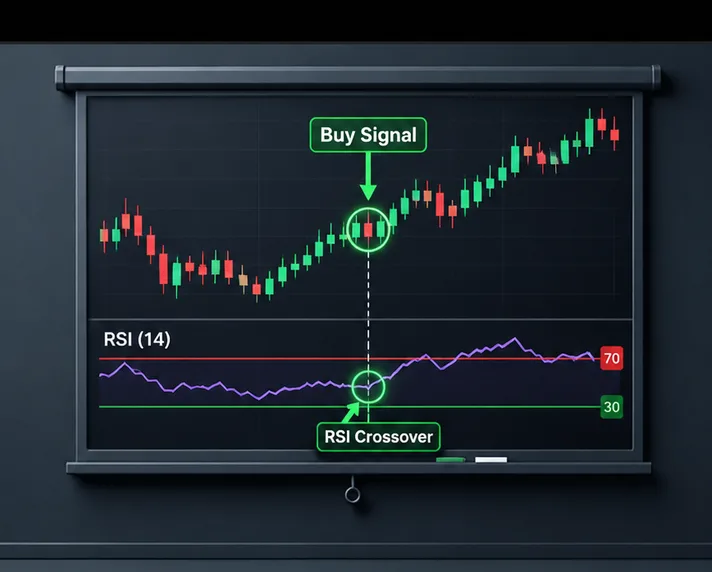
The Relative Strength Index (RSI) compares the size of recent up closes with recent down closes and shows the result between 0 and 100. Its best-known use is spotting overbought (above 70) and oversold (below 30) conditions, but there are other ways to read it. This sample article introduces three types of RSI signal and a simple way to trade one of them.
Why this setup
Overbought does not mean "about to fall". In strong trends RSI can stay above 70 for a long time. Treating RSI as a measure of momentum rather than a reversal alarm makes it more useful. Three common readings are the range shift (in uptrends RSI tends to hold above 40), the failure swing, and divergence between price and RSI. This setup uses a failure swing together with price structure.
Entry rules
- RSI drops below 30.
- RSI bounces, then pulls back again, but this time stays above 30.
- RSI then breaks above the high of its first bounce; that is the signal.
- Check that price has also made a higher low or reclaimed a nearby level.
- Enter on the candle close; for a bearish failure swing above 70, run the same steps in reverse.
Exit and stop
- Place the stop below the price low of the setup.
- Target the nearest resistance, or a 1:2 risk-to-reward ratio.
- Exit early if RSI falls back below 30.
- Use a time stop: if nothing happens within 10 to 15 candles, review the trade.
Risk notes
Counter-trend signals against a strong trend fail often; prefer setups that agree with the higher timeframe. Changing the RSI length changes everything, so test any change before you rely on it.
Important: This is a sample educational strategy, not a buy or sell recommendation. Test every rule first, with a backtest on historical data and then on a demo account, and decide whether to use or adapt it only after you understand how it behaves in different market conditions.
These strategies need testing (backtesting and a demo account) before use. Any buy or sell decision based on them is at your own risk.