Lesson 3 of 7
Position Sizing
1. What Is Position Size?
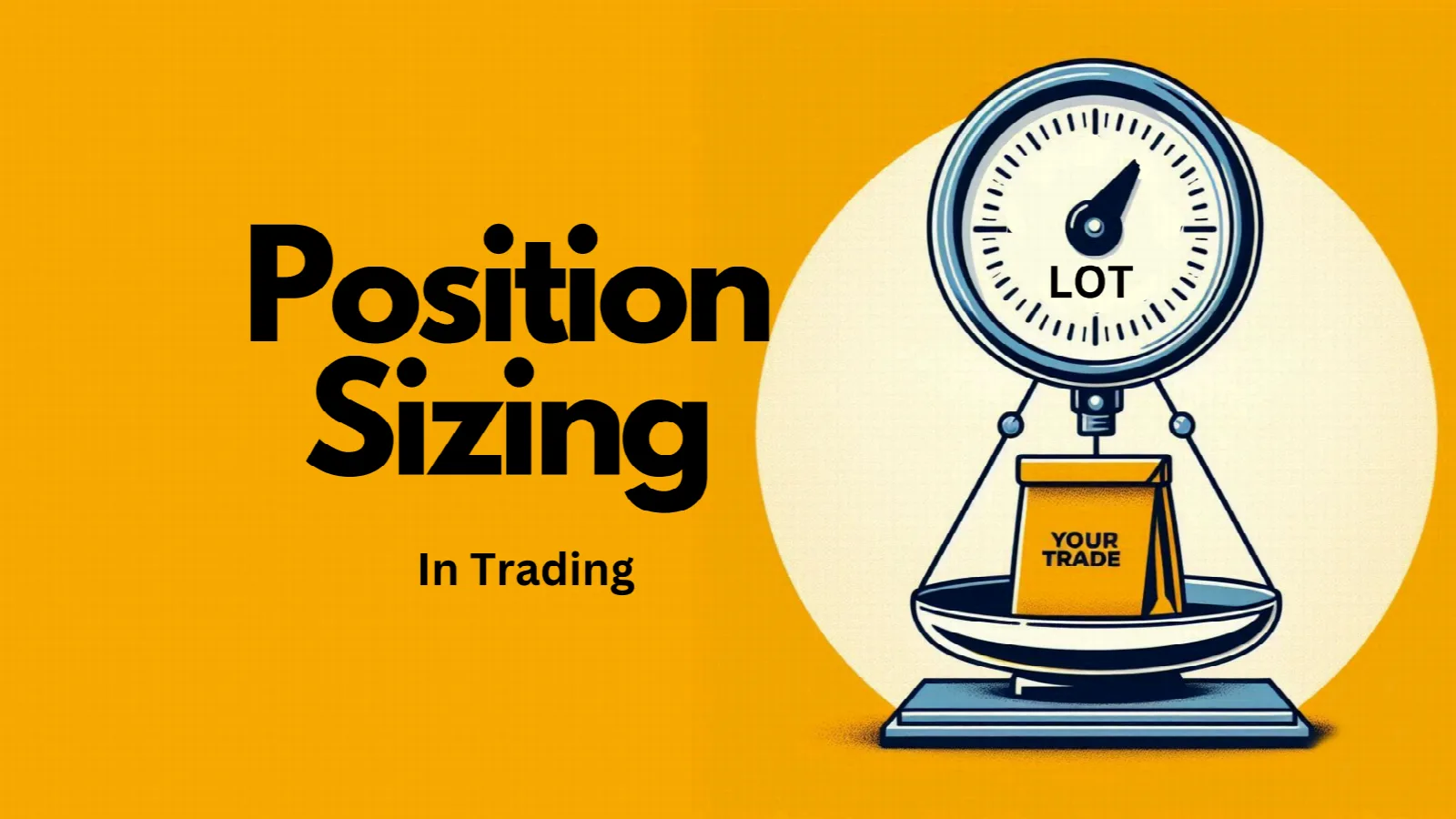
Position Size refers to the amount of an asset or the number of contracts a trader buys or sells in a trade. Simply put, position size determines how much of your capital is allocated to a particular trading position.
Position sizing is one of the most important aspects of money management. If the position size is too large, even a small market movement against your trade can result in a significant loss. On the other hand, choosing an extremely small position size may result in profits that are too limited compared to your capital and accepted risk.
Position size should not be selected solely based on how confident you feel about your market analysis. A trader should first determine how much money they are willing to risk on a trade and then calculate the appropriate position size based on the distance between the entry price and the Stop Loss.
Example:
Suppose your account balance is $1,000, and you decide to risk a maximum of 1% of your capital on each trade. In this case, your maximum acceptable loss per trade is $10.
If buying 100 units of an asset would result in a $10 loss when the Stop Loss is triggered, your appropriate position size would be 100 units.
Therefore, position size should be determined based on your account balance, risk amount, and Stop Loss distance.
2. How to Calculate Position Size in the Cryptocurrency Market
In the cryptocurrency market, position size refers to the amount of cryptocurrency a trader buys or the quantity involved in a sell position or derivatives contract.
To calculate an appropriate position size, you first need to determine your dollar risk and then calculate the distance between your entry price and Stop Loss.
For spot trading and linear futures contracts, you can use a simple formula:
Position Size Formula:
Position Size = Dollar Risk ÷ Distance Between Entry Price and Stop Loss
To use this formula, you must first determine your maximum acceptable risk.
Practical Example:
Suppose your account balance is $2,000, and you want to risk 1% of your capital on each trade.
Account Balance: $2,000
Risk Percentage: 1%
Maximum Acceptable Loss: $20
Bitcoin Entry Price: $50,000
Stop Loss Price: $49,500
Distance Between Entry and Stop Loss: $500
The position size is calculated as follows:
$20 ÷ $500 = 0.04 BTC
Therefore, to limit your potential loss to approximately $20 if the Stop Loss is triggered, you should open a position of 0.04 BTC.
The notional value of this position is $2,000. However, in futures trading, the required margin changes depending on the selected leverage. The risk resulting from the price reaching your Stop Loss remains approximately $20, assuming the order is executed at the intended price.
It is important to remember that trading fees, slippage, and the possibility of Stop Loss execution at a different price can affect the actual loss. These costs should also be considered when calculating position size.
3. How to Calculate Position Size in Forex
In the Forex market, trading volume is generally measured using a unit called a Lot. A lot represents the amount of the base currency being bought or sold in a trade.
Standard lot sizes are generally defined as follows:
Standard Lot: 100,000 units of the base currency
Mini Lot: 10,000 units of the base currency
Micro Lot: 1,000 units of the base currency
Nano Lot: 100 units of the base currency, if supported by the broker
To calculate position size in Forex, you need to determine three main factors: your account balance, risk percentage, and Stop Loss distance measured in Pips.
General Position Size Formula:
Position Size in Lots = Dollar Risk ÷ (Stop Loss Distance in Pips × Pip Value per Standard Lot)
Let's look at a practical example.
Practical Example:
Suppose your account balance is $5,000, and you decide to risk 1% of your capital on each trade.
Account Balance: $5,000
Risk Percentage: 1%
Maximum Acceptable Loss: $50
Stop Loss Distance: 25 Pips
Pip Value per Standard Lot for a pair such as EUR/USD: Approximately $10
The position size is calculated as follows:
$50 ÷ (25 × $10) = 0.20 Lots
Therefore, the appropriate position size is 0.20 lots.
With this position size, if the Stop Loss is triggered after a 25-pip movement, the loss will be approximately $50, assuming a pip value of $10 and excluding trading fees and slippage.
Keep in mind that pip values are not the same for all currency pairs. They depend on the currency pair, the account currency, and exchange rates. Therefore, you should use the actual pip value when calculating your position size.
4. The Relationship Between Account Balance and Position Size
Your account balance is one of the main factors used to determine position size. As your account balance increases, you can trade larger positions while maintaining the same risk percentage. Conversely, when your account balance decreases, your position size should also be reduced accordingly.
One of the most important principles of money management is that position size should be calculated based on your current account balance and acceptable risk, rather than on your expected profit or loss.
Example:
Suppose a trader decides to risk 1% of their account balance on each trade.
| Account Balance | 1% Risk |
|---|---|
| $500 | $5 |
| $1,000 | $10 |
| $2,000 | $20 |
| $5,000 | $50 |
| $10,000 | $100 |
As you can see, the dollar amount at risk increases as the account balance grows, while the risk percentage remains constant.
This approach allows traders to increase their position sizes gradually as their accounts grow and reduce their exposure when their account balances decline.
Why Should You Reduce Position Size When Your Account Balance Decreases?
Suppose your account balance is $2,000, and you trade using a specific position size. After several losing trades, your account balance decreases to $1,500.
If you continue trading with the same position size, each trade may expose a larger percentage of your remaining capital to risk. As a result, further losses can have a greater impact on your account.
For this reason, it is better to review and recalculate your position size regularly based on your current account balance.
5. The Difference Between Margin, Leverage, and Position Size
In financial markets, particularly in cryptocurrency futures and Forex trading, three concepts are extremely important: Margin, Leverage, and Position Size. These concepts are related, but each has a different meaning.
1. Position Size
Position Size refers to the total value or quantity of a trading position opened in the market. For example, if you open a Bitcoin position worth $2,000, your position's notional value is $2,000.
2. Margin
Margin is the amount of capital a trader allocates as collateral to open and maintain a leveraged position with a broker or exchange. It acts as security for the trading position.
For example, if you want to open a $2,000 position using 10x leverage, you would need approximately $200 in initial margin under simplified conditions.
3. Leverage
Leverage allows traders to control a position larger than the amount of capital allocated to that trade.
For example, with 10x leverage, every $1 of margin can provide exposure to a $10 position.
Comparison of Margin, Leverage, and Position Size:
| Concept | Simple Definition |
|---|---|
| Position Size | The total value of the trading position |
| Margin | The capital required to open the position |
| Leverage | A multiplier that increases trading exposure |
Practical Example:
Suppose you want to open a futures position worth $3,000 using 10x leverage.
Position Size: $3,000
Leverage: 10x
Approximate Initial Margin: $300
In this example, you use $300 as margin to open a position worth $3,000.
However, it is important to understand that when the market moves against your position, losses are calculated based on the total position size, not just the initial margin.
If losses increase and the margin level reaches the threshold set by the exchange or broker, your position may be liquidated or automatically closed.
Does Higher Leverage Always Mean Higher Risk?
Not necessarily. If your total position size and Stop Loss remain unchanged, increasing leverage alone does not increase the planned loss if the Stop Loss is reached. Instead, it reduces the amount of margin required to open the position.
However, using high leverage incorrectly often encourages traders to open larger positions. This can expose them to significantly greater losses.
For this reason, position size and acceptable risk should be determined first. Leverage should then be selected according to the trading conditions and account balance.
Conclusion: Part 3
Position sizing is one of the fundamental principles of money management. Before entering any trade, a trader should determine the acceptable risk, Stop Loss distance, and current account balance, then calculate the appropriate position size.
In the cryptocurrency market, position size is generally calculated based on the asset quantity and the distance between the entry price and Stop Loss. In Forex trading, the pip value is also an important factor.
In leveraged trading, understanding the differences between position size, margin, and leverage is equally important. Using high leverage does not automatically mean better money management. Without proper position size control, it can significantly increase the risk of account liquidation.
This content is provided for educational purposes only and does not constitute financial advice or a recommendation to buy or sell any financial asset.
This lesson is for education only and is not a recommendation to buy or sell any asset.