Lesson 4 of 8
Whale and Holder Behavior Analysis
1. What Is a Crypto Whale?
In the cryptocurrency market, a whale refers to an individual, organization, or institution that holds a very large amount of a particular cryptocurrency. Because of the size of their holdings, whales can influence market supply and demand, especially when they make large transactions.
For example, if a wallet holds thousands of Bitcoin, it may be considered a Bitcoin whale. When such a wallet transfers a significant amount of Bitcoin, traders and analysts may pay attention because the transaction could affect market sentiment or liquidity.
However, it is important to understand that every large transaction does not necessarily mean the market will rise or fall. A whale may move assets between personal wallets, transfer funds to an exchange, or move coins into long-term storage. Therefore, whale activity should always be analyzed alongside other market data.

2. Whale Wallet Tracking
Whale wallet tracking is the process of monitoring cryptocurrency wallets that hold large amounts of digital assets. Since many blockchain transactions are publicly recorded, analysts can examine wallet activity and follow large transfers between addresses.
One important factor analysts monitor is the movement of coins to and from cryptocurrency exchanges.
When a large amount of cryptocurrency is transferred to an exchange, it may indicate that the wallet owner is preparing to sell. This can increase potential selling pressure in the market. On the other hand, when large amounts of cryptocurrency are withdrawn from exchanges and transferred to private wallets, it may suggest that investors intend to hold their assets for a longer period.
However, these movements do not always reveal the owner's actual intentions. For example, a transfer to an exchange does not necessarily mean an immediate sale. Similarly, withdrawing coins from an exchange does not guarantee that the investor plans to hold them permanently.
For this reason, whale wallet tracking is most useful when combined with trading volume, price movements, exchange flows, and other on-chain indicators.

3. What Are Cryptocurrency Accumulation and Distribution?
Accumulation and distribution are two important concepts used to understand the behavior of large investors in cryptocurrency markets.
Accumulation occurs when investors gradually increase their holdings of a cryptocurrency. This often happens when the market is moving sideways or prices have declined. Some investors use these periods to purchase assets at lower prices, expecting potential growth in the future.
Distribution is the opposite process. It occurs when investors gradually reduce their holdings by transferring or selling their assets. This behavior may happen after a significant price increase or when investors decide to take profits.
For example, if large wallets gradually increase their Bitcoin holdings while the market price remains relatively stable, analysts may interpret this activity as a possible accumulation phase.
On the other hand, if large wallets begin reducing their holdings and transferring coins to exchanges, it may indicate a possible distribution phase.
It is important to remember that accumulation does not guarantee a future price increase, and distribution does not always mean that the market is about to decline. These patterns should be evaluated together with other market indicators.
4. Short-Term and Long-Term Holders
Cryptocurrency investors can be divided into two general groups based on how long they hold their assets: Short-Term Holders (STH) and Long-Term Holders (LTH).
Short-term holders are investors who have held their coins for a relatively short period. They are generally more sensitive to market fluctuations and may react more quickly to price changes. Their behavior can provide useful information about short-term market sentiment.
Long-term holders are investors who keep their cryptocurrencies for extended periods. They are often less affected by short-term price movements and may continue holding their assets even during periods of market volatility.
In Bitcoin on-chain analysis, a commonly used classification considers coins that have not moved for less than 155 days as short-term holder supply, while coins that have remained inactive for more than 155 days are generally classified as long-term holder supply.
This 155-day threshold is a widely used analytical convention for Bitcoin. It should not be considered a universal rule for every cryptocurrency.
Monitoring the behavior of these two groups can help analysts better understand market conditions. For example, an increase in long-term holder supply may suggest that more investors are choosing to hold their Bitcoin rather than trade it frequently.
5. What Is the HODL Waves Indicator?
HODL Waves is an on-chain indicator that shows how long cryptocurrency coins have remained inactive since their last movement.
This indicator divides the circulating supply of a cryptocurrency into different age groups. Each group represents coins that have not moved for a specific period, such as less than one day, one week, one month, six months, or several years.
By examining these groups, analysts can understand how the holding behavior of market participants changes over time.
For example, if the share of Bitcoin that has not moved for several years increases, it may indicate that a larger portion of investors is choosing to hold their coins for the long term.
In contrast, if older coins begin moving and their share decreases, it may suggest that some long-term holders are becoming active again.
However, a coin movement does not necessarily mean that the asset has been sold. Transfers between personal wallets or changes in custody can also affect HODL Waves data.Therefore, this indicator is best used alongside other on-chain metrics to gain a more complete understanding of investor behavior.
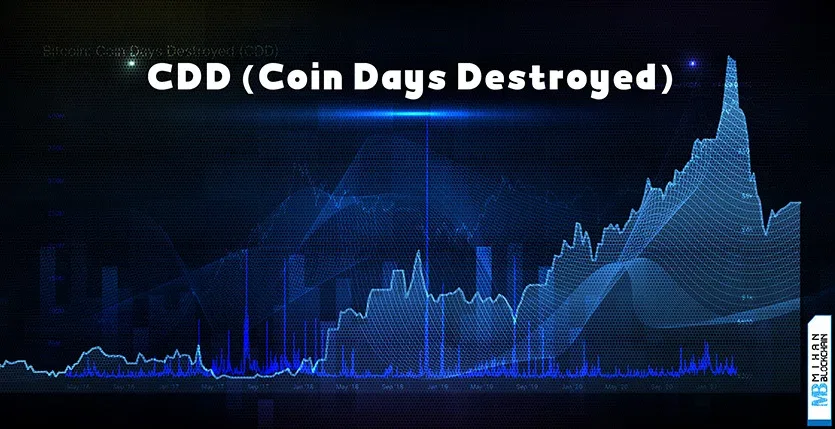
6. What Is Coin Days Destroyed (CDD)?
Coin Days Destroyed (CDD) is an on-chain indicator that measures the movement of coins based on how long they have remained inactive.
The main idea behind this indicator is that older coins carry more accumulated coin days than recently moved coins. When these older coins move, their accumulated coin days are considered destroyed.
For example, imagine that an investor holds 10 Bitcoin without moving them for 100 days. If those coins are transferred, the transaction generates:
10 BTC × 100 days = 1,000 Coin Days Destroyed
This means that 1,000 coin days have been destroyed through that transaction.
When CDD increases significantly, it may indicate that older coins are becoming active again. This can be important because long-term holders are often considered a group with a different investment behavior from short-term traders.
However, an increase in CDD does not necessarily mean that investors are selling their coins. They may simply be transferring them between wallets or changing their storage arrangements.
For this reason, analysts usually examine CDD alongside price movements, trading volume, exchange flows, and other on-chain indicators.
Warning: This content has been prepared solely for educational purposes and to increase awareness of the cryptocurrency market. It does not constitute a recommendation to buy or sell any digital asset.
This lesson is for education only and is not a recommendation to buy or sell any asset.